Friday, 25 September 2015

Genere Research


Genre Research
Genre: Psychological  thriller
Thriller


Thriller is a genre of literature, film, videogame stories and television programming that uses suspense, tension, and excitement as its main elements. Thrillers heavily stimulate the viewer's moods, giving them a high level of anticipation, ultra-heightened expectation, uncertainty, surprise, anxiety and terror. They also provide the sudden rush of excitement, and exhilaration that drive the narrative, sometimes subtly with peaks and lulls, sometimes at a constant, breakneck pace. It keeps the audience on the "edge of their seats".
Suspense  -  Suspense is a crucial characteristic of the thriller genre. It gives the viewer a feeling of pleasurable fascination and excitement mixed with apprehension, uncertainty, anticipation, tension, and anxiety. These develop from unpredictable, mysterious and rousing events during the narrative, which make the viewer or reader think about the outcome of certain actions. It also gives the person the so-called "on-edge" feeling. Suspense builds in order to make those final moments, no matter how short, the most memorable. They are the defining features in a thriller.
The primary elements of the thriller genre:


  • The protagonist(s) faces death, either his and/or her or somebody else's.
  • The force(s) of the antagonist's must initially be cleverer and/or stronger than the protagonist's.
  • The main storyline for the protagonist is either a quest or a character that cannot be put down.
  • The main plotline focuses on a mystery that must be solved.
  • The film's narrative construction is dominated by the protagonist's point of view.
  • There may be a suspenseful and atmospheric soundtrack for the scenes of suspense.
  • All action and characters must be credibly realistic or natural in their representation on screen.
  • The two major themes that underpin the thriller genre are the desire for justice and the morality of individuals.
  • One small, but significant, aspect of a thriller is the presence of innocence in what is seen as an essentially corrupt world.
  • The protagonist(s) and antagonist(s) may battle, themselves and each other, not just on a physical level, but on a mental one as well.
  • Either by accident or their own curiousness, each character is dragged into a dangerous conflict or situation that they are not prepared to resolve.


Characters - Characters usually include criminals, stalkers, assassins, innocent victims (often on the run), menaced women, characters with deep dark pasts, psychotic individuals, spree killers, sociopaths, agents, terrorists, cops and escaped cons, private eyes, people involved in twisted relationships, world-weary men and women, psycho-fiends, and more. The themes frequently include terrorism, political conspiracy, pursuit, or romantic triangles leading to murder.
Setting - Thrillers take place mostly in ordinary suburbs and cities, although sometimes they may take place wholly or partly in exotic settings such as foreign cities, deserts, polar regions, or the high seas. These usually tough, resourceful, but essentially ordinary heroes are pitted against villains determined to destroy them, their country, or the stability of the free world. Often in a thriller movie, the protagonist is faced with what seem to be insurmountable problems in his mission, carried out against a ticking clock, the stakes are high and although resourceful, they face personal dilemmas along the way forcing them to make sacrifices for others.


Some examples of thrillers are


Research into psychic ability:

The lead protagonist within our short film named Lily experiences a stressful event, she is involved in an accident leaving her with severe head injuries and comatosed for a week. When she awakes she experiences visions of peoples deaths through touch. She has gained a psychic ability.
This story line inspired me to research into the topic of psychic abilites online, to discover if people truly experience these abilities or if they are fake and more logical evidence can be provided.

Through research I discovered a list of psychic abilities one titled 'Death-Warning' described as a vision of a living person prior to his or hers death. This description relates to the same ability as our lead character creating a form of realism within the context of our story line.This ability often occurs within people who preform mysticism. This refers to men and women who believe in intuitive spiritual revelation.


Within online discussions people argue that psychic abilities are completely true whereas others argue the similarities between experiencing an ability and personality disorders such as schizophrenia. Schizophrenia is a mental disorder chatergorized by abnormal social behaviour and failure to recognise reality.


The context within our story relies on the audiences decision as to whether Lily truly gained a psychic ability or a mental disorder due to her high stress levels, however the intention within the story line is that Lily formed a psychic ability to forsee deaths following her head injury.

Script: Possible Ending 2


Script: Possible Ending 1


Thursday, 24 September 2015

Certificate of our film

What is a film certificate?

In Britain, the certificate of a film is decided by the British Board of Film Classification (BBFC). They act as a form of censorship for films to prevent potentially harmful and inappropriate content being viewed by to a young or impressionable audience. The BBFC have a set of guidelines determining what age rating a film should receive, based on its content. BBFC Examiners look at issues such as discrimination, drugs, horror, imitable behaviour, language, nudity, sex, sexual violence, theme and violence when making decisions. They also consider context, the tone and impact of a work (how it makes the audience feel) and even the release format (for example, as DVDs are watched in the home, there is a higher risk of underage viewing). There are 7 main certificates a film could receive.


The "U" symbol stands for Universal. At this rating, a film should be suitable for an audience of 4 years or less, meaning that there can be none of the questionable content mentioned above. However, the BBFC will allow the use of infrequent use of very mild language at this level (e.g. - "damn" or "hell"). There can also be very mild or comical violence, as well as 'scary scenes', providing they are balanced by reassuring elements. Although it should be noted that simply because a film has been given a U certificate, does not necessarily mean that it is a 'children's film'.


PG stands for "Parental Guidance". This means that while a film is suitable for general viewing, it may content content that is unsuitable for young children. A PG film should remain suitable for a child audience, but it can explore a few more questionable themes such as bullying, racism or bereavement. There may be use of some mild bad language in a PG film, providing it is not used in an aggressive context. There can also be elements of mild violence, providing it is shown comically or with little graphic detail.


The 12A certificate means that a child under the age of 12 must be accompanied by an adult in order to view a film with this certificate. Strong profanity may be passed at a 12A depending on the frequency and context of its use. Aggressive use of strong profanity is unlikely to be passed at a 12A. Sexual activity may be briefly or discreetly portrayed at a 12A, providing there is no directly explicit content. Sexual references and innuendos should not go beyond what is suitable for young teenagers. If sexual activity is portrayed in a comedic context, BBFC regulators are generally more lenient.


No-one under the age of 15, regardless of accompaniment, is permitted to view a 15 film at the cinema. A 15 certificate film may have strong violence (not overly gruesome), frequent strong language, portrayals of or references to sexual activity, nudity, discrimitatory language or behaviour, or drug use. There is generally no limit to use of profanity in a 15, except for the strongest language, which usually must occur within an acceptable context. There must be little detail given to nudity or sexual activity. Racism, homophobia, and other discriminatory language are permitted in a 15, providing they do not endorse such behaviour.

18 certificate films are intended for viewing only by adults. No-one below the age of 18 is permitted to view these films. These works are considered unsuitable for children. Issues that may arise in an 18 certificate film may include: very strong violence, frequent strong language, strong portrayals of sexual activity (may be real) or sexual violence, strong horror, blood and gore, and discriminatory language and behaviour. There may be racist, homophobic or other discriminatory language at an 18, and the film may explore the themes of these, providing the film does not any legislation. Use of drugs is also permitted in an 18, providing the overall film does not endorse their use.
 
The R18 category is a special and legally-restricted classification primarily for explicit works of consenting sex or strong fetish material involving adults. Films of this category may only be shown to adults in specially licensed cinemas. DVD and videos of R18 films may only be purchased in licensed shops, and cannot be purchased through mail order.


Which certificate would our film receive?

Although our film contains some elements of violence, and some slightly disturbing scenes, both are mostly censored and are kept to a minimum. The degree of violence contained in the film is not severe enough to classify it as a 15 (the most violent moment in the film is when Lily stabs Brett, which only occurs in a vision and is largely censored). As a result, our film would likely be classified as a 12A as its content is mature enough to be unsuitable for younger viewing, but not malicious enough to qualify as a 15. There is also no use of bad language. Thus, we intend to keep violence and disturbing implication to a minimum in order to prevent a breach of this classification.
Research into Psychological Thriller Genre:

Whilst discussing with my group which genre to classify our short film we finalised the choice of Thriller as our intention within scenes is to create suspense and fear through violence. However when researching into Thriller as a genre and its conventions I realised it lacks many similar aspects to other films within the Thriller genre.
This discovery caused me to research into genre hybrids, specifically the Psychological Thriller genre.

Psychological thrillers rely on the fear of the unknown, mystery and several events building to a plot climax. This genre of film relies on character mental instability to provide context.

Psychological thriller conventions

Setting:
The setting during a psychological thriller would provide the audience with a sense of realism, for example a town or suburban location. Through the average setting the sense of fear is heightened within the audience as the illusion that the violent events within the film could happen anywhere is created. For example the film 'Donnie Darko' (2001) takes place in a mundane location.

The setting of Donnie Darko.

Costume:
Continuing with the impression of realism the protagonist is often represented wearing ordinary clothing to create realism surrounding the plot. For example character Clarice Starling's costume within 'Silence of the Lambs' (1991) appears bland and everyday whereas her determined character and events she partakes in juxtaposes this.

Clarice Starling's costume during 'Silence of the Lambs'.

Lighting:
Low key lighting is frequently used to create an audience response of fear. The use of shadows also creates tension throughout films defined with the psychological fear genre through targeting the audiences fear of the unknown. 'The Shining' (1980) uses low key lighting within specifically violent scenes to form an emotional response from the audience.

Low key lighting used within The Shining.

Sound:
High pitched eerie music often accompanies the psychological thriller genre to provide a sense of unease and warn the audience of disruption within the films narrative.


After further research into the Psychological Thriller genre hybrid I concluded that it would be the genre used to identify our film. Our film fits with the thriller genre through a continued use of violent scenes such as the protagonist Lily murdering her boyfriend. The character context of Lily's mental state causing her to see visions of characters deaths defines the films genre as Psychological Thriller.

Wednesday, 23 September 2015

Research Into Genre - Psychological Thriller

Psychological thriller is a specific sub-genre of the broad-ranged thriller and horror genres. It often emphasises the psychology of its characters and their unstable emotional states. However, it often incorporates elements from the mystery and drama genre, in addition to the typical traits of the thriller genre.

Psychological Thriller is categorised into numerous different themes:

  • Reality: The quality of being real. Characters often try to determine what is true and what is not within the narrative. An example of this type of psychological thriller is 'Memento' (2000) in which a man named Leonard (Guy Pearce) is tracking down the man who raped and murdered his wife. However, the difficulty of locating his wife's killer is compounded by the fact that he suffers from a rare, untreatable form of memory loss. Although he can recall details of life before his accident, Leonard cannot remember what happened fifteen minutes ago, where he's going, or why. Hence, he struggles to decipher what is real and what is not.
  • Perception: – A person's own interpretation of the world around them through their senses. Often characters misconceive the world around them, or their perceptions are altered by outside factors within the narrative. An example is 'The Machinist' (2004), in which factory worker Trevor Reznik (Christian Bale) suffers from insomnia so severe that his condition has taken its toll on his weight and his mental health. When Trevor unintentionally causes an on-the-job accident that horribly injures a coworker (Michael Ironside), he begins to become even more troubled. Despite a relationship with Stevie (Jennifer Jason Leigh), an attractive prostitute, Trevor descends further into paranoia, blaming his problems on an enigmatic figure named Ivan (John Sharian). After, this, his perception of reality begins to become distorted.

  • Mind: – The human consciousness; the location for personality, thought, reason, memory, intelligence and emotion. The mind is often used as a location for narrative conflict, where characters battle their own minds to reach a new level of understanding or perception. A good example of this type of psychological thriller is 'Jacob's Ladder' (1990), in which Vietnam War veteran Jacob Singer (Tim Robbins) struggles to maintain his sanity after returning from Southeast Asia. Plagued by hallucinations and flashbacks, Singer rapidly falls apart as the world and people around him morph and twist into disturbing images. His girlfriend, Jezzie (Elizabeth Peña), and ex-wife, Sarah (Patricia Kalember), try to help, but to little avail. Even Singer's chiropractor friend, Louis (Danny Aiello), fails to reach him as he descends into madness.

  • Existence/Purpose: – The object for which something exists; an aim or a goal humans strive towards to understand their reason for existence. Characters often try to discover what their purpose is in their lives and the narrative's conflict often is a way for the characters to discover this purpose. An example of this is 'Taxi Driver' (1976), in which  lonely, disturbed insomniac Travis Bickle (Robert De Niro) takes a job as a New York City taxi driver, haunting the streets nightly, growing increasingly detached from reality as he dreams of cleaning up the filthy city. When Travis meets pretty campaign worker Betsy (Cybill Shepherd), he becomes obsessed with the idea of saving the world, first plotting to assassinate a presidential candidate, then directing his attentions toward rescuing 12-year-old prostitute Iris (Jodie Foster). He then dedicates to this idea to such an extent that it becomes what he believes to be the purpose of his existence.

  • Identity: – The definition of one's self. Characters often are confused about or doubt who they are and try to discover their true identity. They may also display several different identities in a schizophrenic fashion. An example of this type of psychological thriller is 'Mr Brooks' (2007), in which well-respected businessman Earl Brooks (Kevin Costner) has a secret: Beneath his family-man facade lurks a murderous alter-ego named Marshall (William Hurt). Brooks struggles with his addiction to killing, but Marshall enjoys his grisly hobby too much to let go. Finally, Brooks resolves to commit one final murder, but a voyeur (Dane Cook) witnesses it and blackmails him to continue. With a detective (Demi Moore) hot on his trail, Brooks/Marshall must spin an increasingly elaborate web. Within the film, Brooks often finds himself split between these two personalities and struggles to determine who he really is.

  • Death: – The cessation of life. Characters either fear or have a fascination with death. A good example of this is a Japanese film: 'Death Note' (2006). Light Yagami (Tatsuya Fujiwara) is a normal, undistinguished college student, until he discovers an odd notebook lying on the ground, which he soon discovers to have a magic power. If someone's name is written on it while the writer imagines that person's face, he or she will die. Intoxicated with his new godlike power, Light kills those he deems unworthy of life, but a mysterious detective known only as L (Ken'ichi Matsuyama) becomes determined to put a stop to his reign. In the film, Light develops an obsession with death and begins to use his new supernatural power to his own benefit in an almost psychotic manner.

    Research into Thriller genre:


    Tuesday, 22 September 2015

    Ilustrated Film Idea


    film idea 2

    ·         the first scene starts in a dark room with 2 unknown characters having a meeting

    ·         one of the characters hands a folder to the other

    ·         the second character opens the folder and inside is a contract for the character to kill the target stated (main character)

    ·         the second scene is of the main character at work

    ·         we then see the main character walking down the hall when he bumps into a suspicious figure

    ·         the person apologises and the characters carry on as normal

    ·         once the main character has returned to his desk he starts to feel very ill and decides to go home

    ·         when at home he gets even more ill so goes to a doctors

    ·         the doctor tells the character that he has been poisoned and sends him for help at a hospital

    ·         while at the hospital the figure comes to the main characters bedside and tells him that there is not helping him and how he managed to poison the character.


    Monday, 21 September 2015

    Chosen Film Idea

    Lily

    Title: 'Lily'
    Creator: Ross Walker
    Genre: Thriller
    Narrative: Non-linear, open narrative.

    Plot Summary:
    " After receiving a severe knock on the head, 18 year old Lily Ashton is rushed to the emergency room, where she is in a coma for approximately a week. She wakes up to find that she has developed a psychic ability. Specifically, she can foresee the death of anyone she touches; all of which come true. However, when she touches her boyfriend Brett Fletcher, she sees a vision of herself murdering him and becomes determined to disprove it.
    The film opens with Lily being rushed to the emergency room, although the scene is disorientated with flashing lights and blur. The screen fades to black and reopens with Lily waking up from her coma with Brett and a doctor at her bedside. Brett is happy to see that she is awake, while the doctor checks Lily temperature by placing his hand against her forehead. This triggers Lily’s first vision as she sees the doctor being knocked down by a car. She thinks nothing of it and Brett escorts her home. In the hospital corridor, Lily accidentally bumps into a rather nervous looking man, who she foresees dying of a heart attack.
    At home the following morning she hears a news report on the radio saying that a man had had a heart attack while driving, and had hit a local doctor. Lily begins to panic and Brett attempts to calm her, touching her in the process. As a result, Lily foresees herself stabbing Brett. She explains that she has been having visions (though deliberately neglects to mention the vision she had of killing him).
    Another week or so on and Lily has been becoming increasingly hysterical due to her visions, causing Brett to question the strength of their romantic relationship. He argues that she is no longer the person she was and suggests that she seek help. She is angered and grabs a knife from a knife-rack in the kitchen and attempts to attack him in a delusional state. Lily admits that she had seen herself kill Brett, and that there is no way to disprove the prophecy. Brett convinces her to put the knife back, and she does. He argues that all she needs to do is control herself, and the prophecy can never come true. Lily however remains sceptical.
    The film ends with a short scene the same night consisting of a single shot. The shot reveals that the knife Lily had replaced is now gone. The screen then fades to black."


    Research into the Genre: Thriller

    Thriller

    Films, Videogames and TV programmes use tension, excitement and suspense as their main elements throughout their product they're creating. Thrillers has tendencies to heavily stimulate their audiences mood, by adding anticipation, ultra-heightened expectations, surprise, anxiety and terror. It tends to keep the audience 'on the edge of their seat' and wanting to further knowledge causing frustration. The plot builds towards a climax, a thriller usually is a villain-driven plot where he/she is presents obstacles that the protagonist must overcome.  

    The Great Escape - A large group of POW’s plan an escape from a German camp in World War II.


    The Silence of the Lambs - An FBI agent develops a relationship with the notorious serial killer, Dr. Hannibal Lector, in order to gain Lector’s assistance in the hunt for another serial killer.


    North By Northwest - Mistaken for a government agent by foreign spies, an advertising agent travels cross-country trying to survive.


    Personal Film Idea

    Film Idea

    Just a walk in the Park

    Character decided to walk her dog on a normal Tuesday afternoon, she goes to the cupboard under the staircase and pulls her coat out and the lead for her dog. The dog sees the lead and starts jumping about with excitement on his face, she garbs her phone off the mantel place, attention is brought to a family portrait of herself, brother, sister, mother and her father and then puts her headphone into her ears.

    She then leave the house, locking the door behind her. Strolls out of her front garden and walks towards the field which is where the park is held. It begins to rain, she puts her hood up on her coat and slowly start running with her dog (Patch) - she couldn't hear the footsteps behind her which slowly getting faster following the pace of hers. The music blocked out and distracted her from looking behind.

    Without a worry in a world, she decided to carry on the walk into the woods. The evening is ending and night time is beginning, the sun is setting behind Victoria and her dog, though is a lovely view a shadow is lurking behind a tree. Victoria becomes curious of the shadow as she didn't see it before, the black hood seems to be interested in her, but why? who is it? what do they want?

    Beads of sweat drip down Victoria's forehead, you can see the worry on her face. Suddenly Patch starts barking which makes Victoria more hesitant. She starts sprinting towards the end of the wood, she trips and falls (Music changes to a faster pace to build the climax)

    She had fallen on her front, so she turns around for a Mask to peer in her face (screaming) however, no one can hear her. Dogs is barking continuously so, Victoria lets go for him to escape. Panicking and trying to escape, the man in the mask smacks her with a massive stick which has fallen from the tree above them both. He drags her away, which the audience can see. Close up shot of her headphones which are left behind her, showing that the same song is paying.

    He pulls down his hood and it's a face we have seen before...? Her brother? why? what's his purpose?
    Close up on his grin to emphasises how twisted his mental state is.

    Group 8: Chosen film idea.

    Within a group discussion we have chosen to create Ross's short story idea entitled 'Lily'.

    Title: 'Lily'
    Creator: Ross Walker
    Genre: Thriller
    Narrative: Non-linear, open narratrive.

    Plot Summary:
    "After receiving a severe knock on the head, 18 year old Lily Ashton is rushed to the emergency room, where she is in a coma for approximately a week. She wakes up to find that she has developed a psychic ability. Specifically, she can foresee the death of anyone she touches; all of which come true. However, when she touches her boyfriend Brett Fletcher, she sees a vision of herself murdering him and becomes determined to disprove it.
    The film opens with Lily being rushed to the emergency room, although the scene is disorientated with flashing lights and blur. The screen fades to black and reopens with Lily waking up from her coma with Brett and a doctor at her bedside. Brett is happy to see that she is awake, while the doctor checks Lily temperature by placing his hand against her forehead. This triggers Lily’s first vision as she sees the doctor being knocked down by a car. She thinks nothing of it and Brett escorts her home. In the hospital corridor, Lily accidentally bumps into a rather nervous looking man, who she foresees dying of a heart attack.
    At home the following morning she hears a news report on the radio saying that a man had had a heart attack while driving, and had hit a local doctor. Lily begins to panic and Brett attempts to calm her, touching her in the process. As a result, Lily foresees herself stabbing Brett. She explains that she has been having visions (though deliberately neglects to mention the vision she had of killing him).
    Another week or so on and Lily has been becoming increasingly hysterical due to her visions, causing Brett to question the strength of their romantic relationship. He argues that she is no longer the person she was and suggests that she seek help. She is angered and grabs a knife from a knife-rack in the kitchen and attempts to attack him in a delusional state. Lily admits that she had seen herself kill Brett, and that there is no way to disprove the prophecy. Brett convinces her to put the knife back, and she does. He argues that all she needs to do is control herself, and the prophecy can never come true. Lily however remains sceptical.
    The film ends with a short scene the same night consisting of a single shot. The shot reveals that the knife Lily had replaced is now gone. The screen then fades to black."


    Friday, 18 September 2015

    Short Film Analysis: Breathe.

    Title: Breathe
    Genre: Horror/ Thriller
    Length: 5 minutes
    Creator: Toby Meakins

    Awarded with the Maria Best Short Film Award.


    BREATHE from Toby Meakins on Vimeo.


    The film opens with an establishing shot showing a well-dressed male character centred within a deep space shot setting up for a ritual. His costume enforces the idea upon the audience that he is trustworthy. The setting is exhibited within this opening clip and represented as a church to the audience through the props of biblical wall hangings in addition to the mise-en-scene of high ceilings and stain glass windows, each holding connotations of religion. Juxtaposed to the ideology that churches are a safe haven the setting appears dishevelled featuring dirty walls and flooring. A twist within the story line is foreshadowed to the audience through low-key lighting as well as eerie, high pitched music providing the film with a sinister atmosphere.


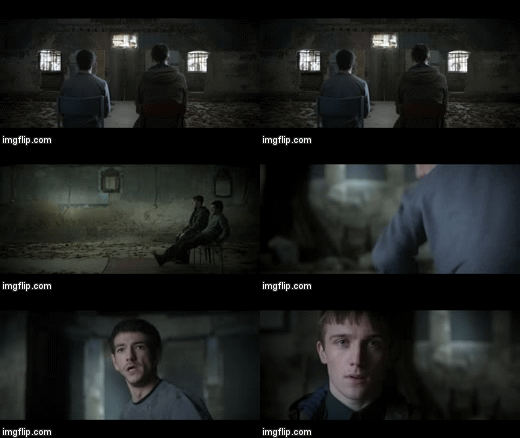
    A sound bridge of a disagreeing voice over allows the clip to cut to a mid-shot whilst keeping good continuity. The mid-shot introduces us to a second male character, his body language appears reserved whilst his costume of a loose jumper suggests he is delicate. The camera dolly’s in isolating the two characters whilst high pitched music continues to play. The flow of the shots is very slow paced creating tension.


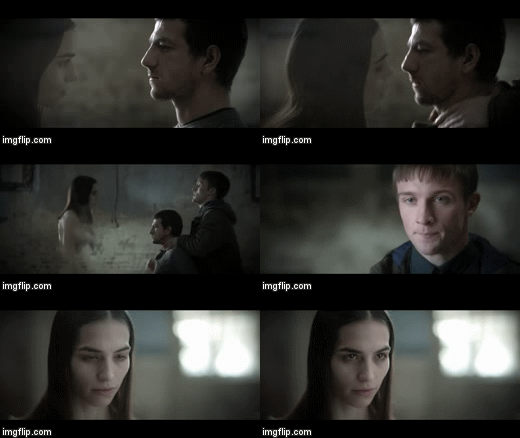
    A cut leads the camera behind the two characters within a mid-shot, allowing the audience to achieve a sense of being their within the setting and heightening the tension within. A ghost female figure appears due to after effects. She is centred within the deep space shot indicating she is the main focus within the film, the non-diegetic music progresses to incidental as the ghoulish sounds mirror the on screen context and reach a peak in volume.


    The shots which follow are extremely fast paced emphasising the second males shock from the appearance of the ghost, further proven through facial expression. Juxtaposed to this the first male character appears calm implying to the audience this is a ritual he has performed several times before. Shot reverse shot editing is used throughout dialogue where the second male reluctantly agrees to try the procedure for a second time.


    A close-up presents the original male character with a persuasive facial expression. Chiaroscuro is used casting a harsh shadow along one side of his face. This connotes both a good and evil side to the character implying to the audience there is more to the male that meets the eye and he is a possible danger.


    The following shot is a medium close up allowing the audience to witness the second male’s tense, shocked facial expression. The ghost is shown touching his lip in a tempting manner. Shallow depth of field is used to cause the audience to focus on the characters interaction. Despite this the first male is clearly shown to be always watching the ghost female in a monitoring manner. The following shots return to a slow pace as the first male leaves the second alone with the ghost.


    The context within the story is revealed within these fast paced clips, whilst the second male holds his breath to interact with the spirit the first begins to choke him. His breath is visualised through after effects shown to be entering the ghosts ‘body’, this represents him breathing his life into her, reviving her for the ending of the short film.


    The killing sequence is finalised by a cut to a close up expressing the second male’s lifeless eyes. High key lighting is used to suggest he died an innocent victim.


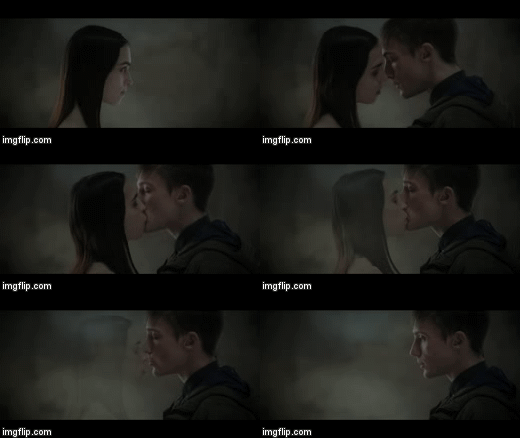
    The true relationship between the male and the female ghost is revealed through a medium close-up of the two kissing passionately. A plot twist shows the woman fading back to a ghost signifying that by killing a person she only gets to live for a few moments.


    An ariel shot presents the male removing the corpse suggesting this is a routine carried out many times before forming a sinister mood the film. The film finalises with a fade to black.

    The short film subverts Todorov’s theory of narrative as it does not end with re-equilibrium instead with murder and disruption within society.